No data vendor needed
Local businesses come straight from the map. No Apollo or Hunter key, on every plan.
Pravadh SI is the intelligence layer on the CRM you already run — not a bigger warehouse and not a send-only blast tool. We tell the team who to contact, why, and what to send, then keep every deal moving with a dated next step and the right sales move. You approve every send. The mailbox is ramped so the domain stays clean.
0
Live connectors
0
Send paths
0
AI providers, including yours
0
Seniority levels in Finder
Finder
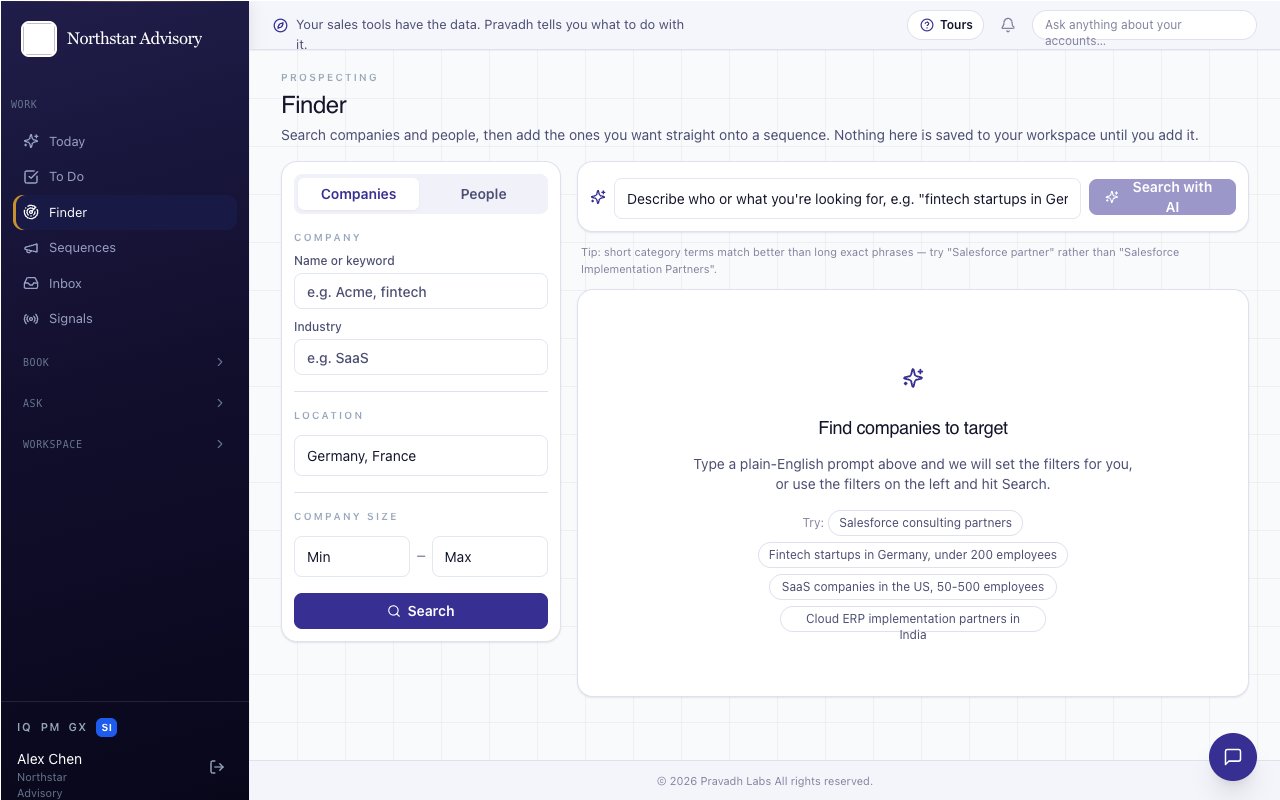
Type what you’re looking for the way you’d describe it to a colleague. Finder maps it onto Apollo’s real-time company and people search, with grouped filters in the sidebar for when you want to refine by hand.
Maps lead finder
Not every buyer is in a contact database. Say what you want and where (or just “nearby”) and Pravadh SI finds the businesses on the map, reads each website for emails and phone numbers, and checks for Salesforce signals when you ask for them.
Local businesses come straight from the map. No Apollo or Hunter key, on every plan.
Each business's own website is read for email addresses, phone numbers and LinkedIn.
Spot companies running Salesforce (web forms, chat, Pardot, Marketing Cloud) or selling Salesforce services.
Save picks to Leads or straight into a sequence. Businesses already in your book are flagged.
Describe a target company or person in plain English and Finder turns it into a live Apollo search — filtered by industry, geography, headcount, and any of 11 seniority levels. On-page suggestions and example prompts help you land on a search that actually returns results, and every match can be added to your pipeline in one click.
Type “nearby dentists” or “Salesforce partners in Pune” and get local businesses from the map, with emails and phones read from each company's website. No Apollo or Hunter needed.
Every reply lands in one searchable, filterable table that shows which of your mailboxes it came back to. A dashboard ranks your mailboxes by replies and reply rate, so you know which sender address works best.
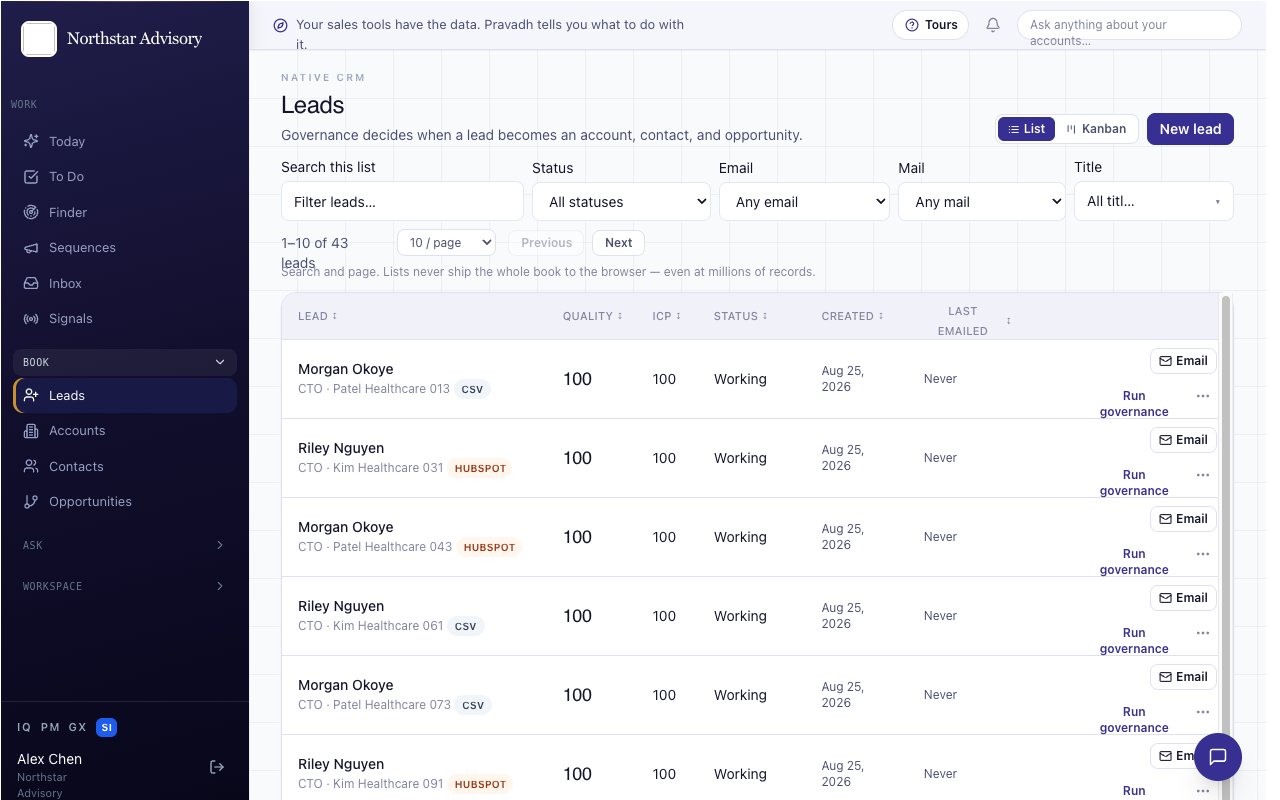
Lead → account and contact → opportunity. This is the system of record for qualification. Integrated CRMs receive a copy when a rule says they should.
Every account and contact score has a breakdown and a written why. We never ship a lone number.
Who to contact, why they fit, why now, what to do, and a suggested message — with feedback that trains the next briefing.
You set the quality and ICP bars. Optional LLM quality gate uses Pravadh AI or the model you bring.
CSV plus Salesforce, HubSpot, Zoho, and Pipedrive on your credentials. Apollo and Hunter connect with your own key — lookups are never charged by Pravadh. Unauthorized LinkedIn collection is not a feature on any plan.
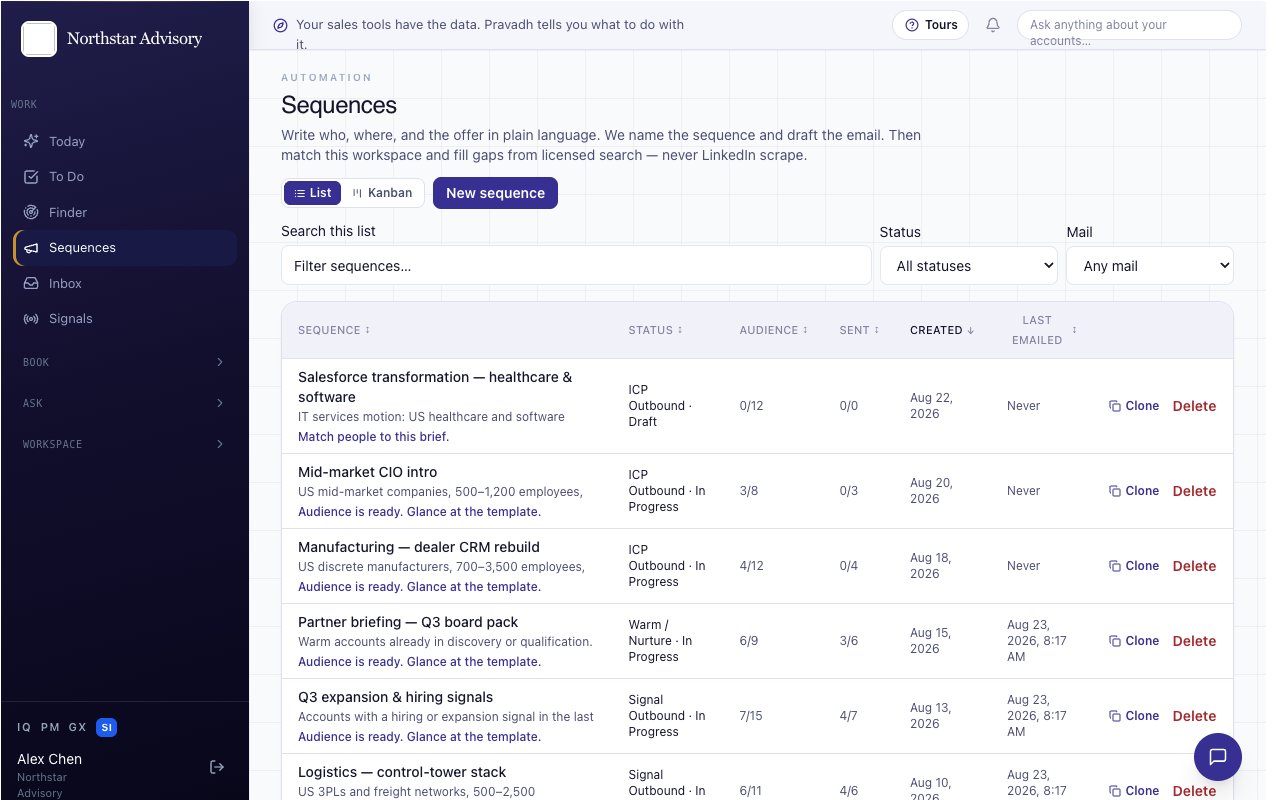
Multi-step email sequences with per-recipient send timing, a scheduled start date you can see on every sequence, open/click tracking, and automatic reply detection that stops a sequence the moment someone replies — no more marking it done by hand. SPF/DKIM/DMARC are checked per sender, a bounce guard pauses a sender automatically after repeated hard bounces, and every login is paced with a daily ceiling and randomized gaps between emails.
SMS and WhatsApp send through the Twilio, Telnyx, or MSG91 account you connect. Voice (a module) uses your Retell account. Calls and LinkedIn touches are logged on the lead. Pravadh does not send LinkedIn messages.
Pravadh AI runs with no setup. An owner or admin allows the organization to connect its own models: OpenAI, Anthropic, Gemini, or Cursor. Personal keys and one shared organization key are both supported. The same Docker image still moves to your own server.
In Briefing, or from a connected ChatGPT, Claude, Gemini, or Cursor, say create a campaign or set a follow-up. In the app you press Confirm. External tools call this site — you do not stand up your own MCP server. A send still waits for a person.
Close deals
Most tools stop at the reply. Deals are lost after it — a follow-up that slips, an objection nobody answers, a buyer nobody identified. The Close Engine gives every deal a dated next step, picks the right sales move, drafts it, and holds the team to doing it. You still approve every send.
Close deals
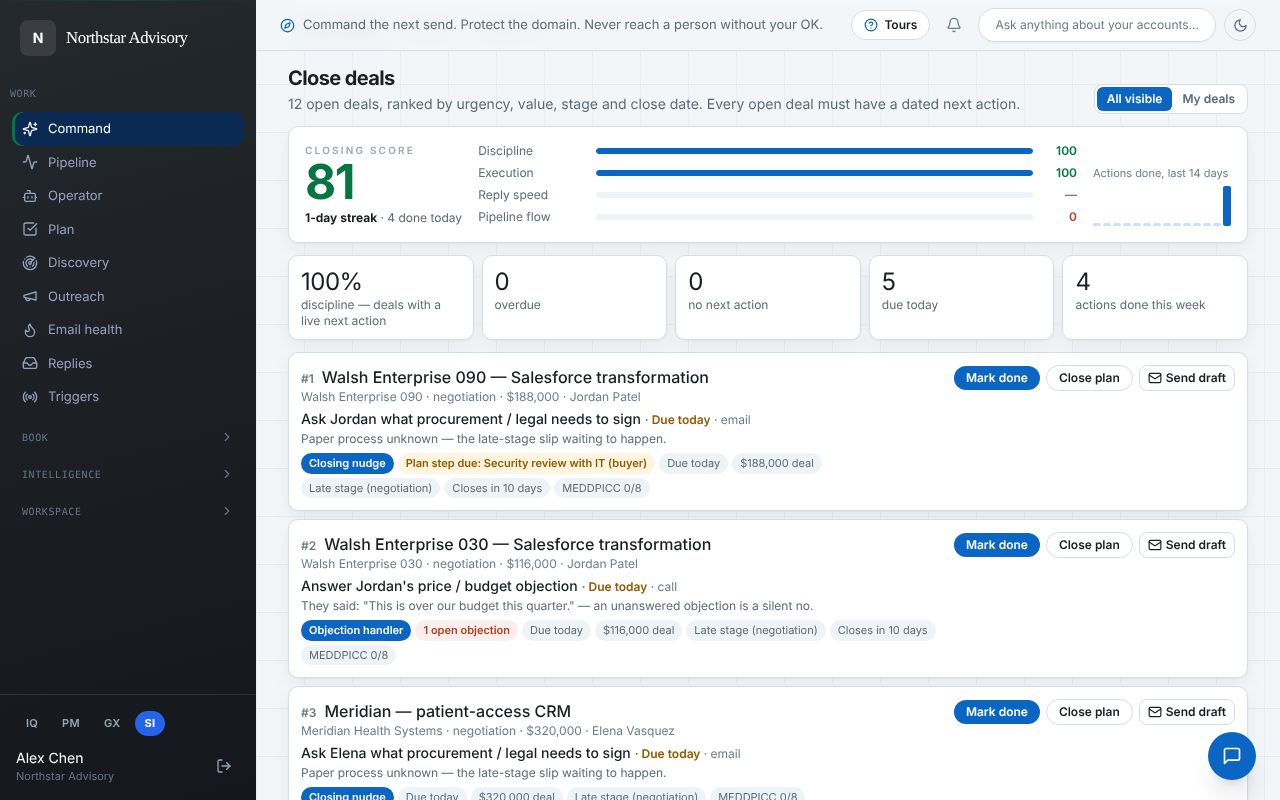
The Closing Score, then every open deal ranked with its next action, the sales skill behind it, and a draft to send.
The rule is simple: an open deal always has a dated next action. Today ranks every deal by urgency, value, stage, and close date — and shows why it ranked there.
Answer a hot reply the same day, find the economic buyer, arm a champion with a one-pager, agree a mutual action plan, confirm the signer — each with an email drafted from real deal facts.
When a buyer replies, SI logs any objection in their own words — price, timing, a competitor, “we already have one” — moves a hot deal forward, and queues the right answer.
Mark a deal lost with a reason and SI queues polite check-ins at 30, 60, and 90 days. If they come back interested, the deal reopens by itself.
A daily Closing Score for discipline, execution, reply speed, and pipeline flow, a streak, and a Monday report — plus win/loss coaching from your own closed deals.
Set follow-up deadlines per stage, turn skills on or off, and write your own objection replies. Every suggestion follows it from then on.
Send smarter
Gmail and Outlook limit each login, not each address, and aliases share that limit. Most sending tools answer a busy quarter by selling you more mailboxes. Pravadh SI plans the sending first, so you email only the people your goal needs, on the mailboxes you already have — and when you do need more, it tells you exactly how many logins to add.
Adds up what every mailbox login can safely send — warm-up ramp and a 40-a-day ceiling per login — against what every live sequence still owes, then shows the date each one finishes and which will run late.
Say how many interested replies you want. Pravadh SI uses your own reply history to work out how many people need an email, keeps the best-fit ones on the list, and parks the rest. One click undoes it.
Every sequence can draw on every pooled mailbox, so one sequence never runs late while another mailbox sits idle. Follow-ups still come from the mailbox that sent the first email, in the same thread.
High-priority sequences get the day's capacity first, so an event deadline is never missed. The lowest-fit people can skip the last follow-up, the email least likely to get a reply.
Inside the workspace
Sequences
Reply detection stops a sequence automatically. A bounce guard pauses a sender after repeated hard bounces.
Leads
Quality and ICP scores ship with a breakdown, not a lone number.